
How to Start a Backyard Pond or Water Garden
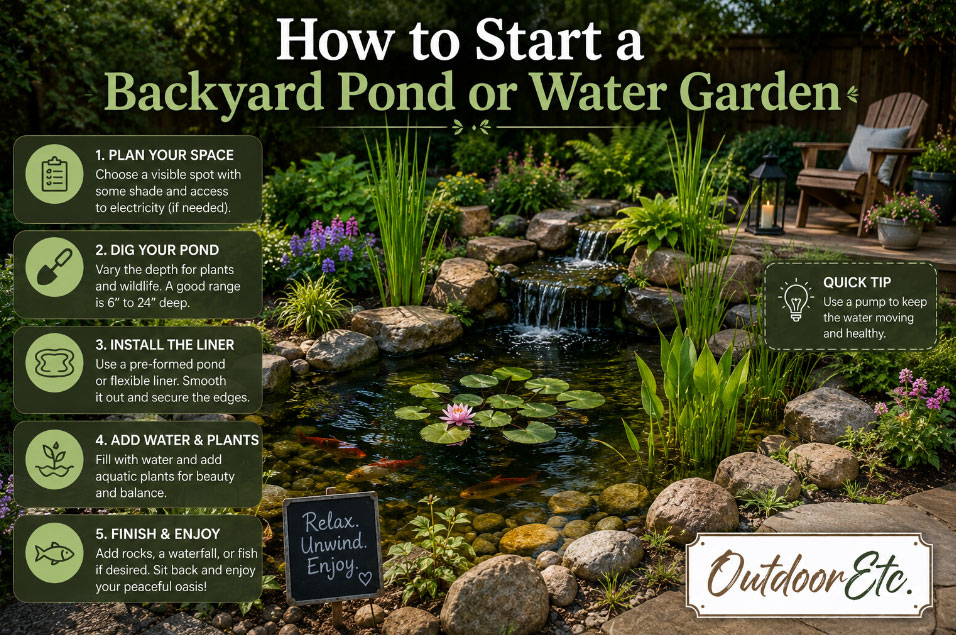
There's a particular sound that changes a backyard: water moving over stone. Not the hiss of a sprinkler or the drone of a pool filter, but the low, irregular trickle of a small waterfall finding its way into a pool below. Once you've heard it from your own patio, the rest of the yard starts to feel unfinished by comparison.
Building a backyard pond or water garden is one of the few home projects that pays you back in more than resale value. It pays back in frogs that show up uninvited, dragonflies that hover like small helicopters, and a spot to sit with coffee that didn't exist the year before. It's also, contrary to what the big-box aisle of pond kits might suggest, a project that rewards planning far more than it rewards impulse-buying a liner on a Saturday afternoon.
This guide walks through the whole process: what a water garden actually is, how to choose a site, what equipment you truly need versus what's optional, how to plant it, how to keep the water healthy, and what it costs. Real addresses and organizations are included throughout so you can see working examples of water gardens in person, not just in photos.
What's the Difference Between a Pond and a Water Garden?
The terms get used interchangeably, and for casual purposes that's fine, but they describe two slightly different goals.
A water garden is built around plants. The waterlilies, lotus, iris, and marginal plants are the point, and any fish are secondary — often just mosquito-eating minnows rather than koi. Water gardens tend to be shallower and more heavily planted, sometimes with 50 to 60 percent of the surface covered in foliage.
A backyard pond — especially a koi pond — is built around fish. It needs greater depth, stronger filtration, and less plant coverage so the fish have open swimming room and owners have a clear view of them.
Most backyard installations end up somewhere in between: a lightly stocked pond with a healthy population of plants doing double duty as natural filtration. Knowing which end of that spectrum you're aiming for will shape almost every decision that follows, from depth to pump size.
Before You Break Ground
Reading Your Sun and Shade
Waterlilies generally need five to six hours of direct sun to bloom well; most marginal and bog plants tolerate partial shade. Watch your prospective site for a full day, or at least recall it honestly — a spot that looks sunny in April can sit in full shade once a maple leafs out in June. Too much shade limits blooming; too much sun, paired with too few plants, invites algae.
Sizing It and Digging Deep Enough
A common beginner mistake is going too small. A pond under 100 gallons swings wildly in temperature and water chemistry, which stresses fish and plants alike and makes maintenance harder, not easier. Most water gardening references suggest starting no smaller than roughly 150–300 gallons for a first pond — a modest 6-by-8-foot footprint at 18–24 inches deep gets you into a workable range.
Depth matters as much as surface area. In climates with real winters, a pond needs at least one zone 24 inches deep or more so fish can survive below the ice line. In warmer regions, 18 inches is often sufficient. Build in at least two depth shelves: a shallow marginal shelf near the edge (6–12 inches) for plants that like their roots wet but not submerged, and a deeper zone for waterlilies and fish.
Checking Codes, Utilities, and Safety Rules
This is the step people skip and regret. Before any digging:
- Call before you dig. In the United States, dial 811 or visit call811.com at least a few business days ahead so utility companies can mark buried gas, electric, and cable lines. It's free, and it's the law in most states.
- Check your municipal code. Many cities require fencing or a permit for ponds over 18–24 inches deep, particularly if young children are in the household or neighborhood.
- Ask your HOA, if you have one — some restrict visible water features or require design approval.
- Locate a GFCI outlet or plan to install one, since pumps and lighting need ground-fault protection near water.
Choosing the Right Spot in the Yard
Beyond sunlight, a few practical factors separate a pond you'll enjoy from one you'll fight with:
- Avoid the base of a hill or any low point where runoff collects — fertilizer and topsoil washing in after every rain will feed algae blooms relentlessly.
- Keep some distance from large deciduous trees. A pond directly under an oak looks lovely until autumn, when it becomes a net for a season's worth of leaves.
- Stay within reach of a garden hose and an electrical source. Running a hundred feet of extension cord across the lawn every water-change day gets old fast.
- Pick a spot visible from where you actually sit — a kitchen window, a deck, a porch. A pond tucked in a back corner gets forgotten; one you can see daily gets tended.
The Core Components of a Backyard Pond
Every functioning pond, from a $200 preformed kit to a $20,000 koi habitat, relies on the same basic parts.
The Liner
Flexible rubber liner — usually EPDM, the same material used on some roof membranes — is the standard choice for custom-shaped ponds because it can handle irregular contours and is highly puncture-resistant. Preformed rigid liners are easier for first-timers but limit you to the manufacturer's shape and depth. Either way, install an underlayment (old carpet padding works, but purpose-made geotextile fabric is better) beneath the liner to protect it from sharp rocks and roots.
The Pump and Filtration
The pump is the heart of the system, circulating water through mechanical and biological filtration and typically powering a waterfall or fountain. As a rule of thumb, aim to circulate the entire pond volume roughly once every one to two hours. A 500-gallon pond, for instance, generally wants a pump rated around 250–500 gallons per hour, adjusted for the height and length of any waterfall run, since elevation reduces flow.
Filtration comes in two forms working together:
- Mechanical filtration physically strains out debris — leaves, sediment, uneaten food.
- Biological filtration hosts colonies of beneficial bacteria that convert fish waste and decaying matter into less harmful compounds, which is the same nitrogen cycle that governs aquariums, just outdoors and on a larger scale.
The Skimmer
A skimmer sits at the water's surface and pulls in floating debris before it sinks and decomposes, which keeps nutrient levels — and therefore algae — lower. It's optional on a heavily planted water garden with few fish, but close to essential on a koi pond.
Edging and Underlayment
The visible border of rock, flagstone, or paver does more than look finished — it hides and protects the liner's edge from UV degradation and holds it in place. Overlapping the liner slightly under the edging stones, rather than cutting it flush, prevents slow leaks at the waterline as the ground settles over the first year.
Step-by-Step: Building the Pond
- Mark the outline with a garden hose or spray paint, standing back periodically to check the shape from different angles.
- Excavate in tiers — outer marginal shelf first, then the deeper center. Keep the rim level all the way around using a long board and a bubble level; an uneven rim is the single most common flaw in DIY ponds and it's visible forever once water is added.
- Remove sharp debris and add two to three inches of sand or underlayment fabric across the entire excavation.
- Lay the liner loosely, allowing slack to settle into the contours rather than stretching it taut, which strains seams.
- Begin filling with water as you tuck and adjust the liner into corners — the weight of the water does most of the shaping work for you.
- Trim the liner, leaving 12–18 inches of overhang beyond the planned edge.
- Install the pump, filter, and skimmer per the manufacturer's instructions, then run the system before adding any final edging, to confirm there are no leaks.
- Set the edging stones, overlapping the liner underneath them, and backfill behind the edge with soil for a natural transition.
- Let the water sit for 24–48 hours before adding plants, and longer — up to a week — before introducing fish, so chlorine or chloramine has time to dissipate or be neutralized with a dechlorinator.
Planting Your Water Garden
Aquatic plants aren't just decoration; they're the pond's natural filtration and shade system, competing with algae for the same nutrients and light. A balanced water garden typically uses plants from four zones:
- Deep-water plants, rooted in pots at the bottom of the deepest zone, with leaves and blooms floating on the surface. Hardy and tropical waterlilies are the classic example, along with lotus for larger ponds.
- Floating plants, which drift freely without being rooted at all — water lettuce and water hyacinth are common, though check local regulations, since both are considered invasive in parts of the southern United States.
- Marginal (shallow-water) plants, potted on the shelf just below the surface — pickerel rush, dwarf cattail, and Japanese iris are reliable choices that also soften the pond's edge visually.
- Submerged oxygenating plants, like hornwort or anacharis, which grow entirely underwater and compete directly with algae for excess nutrients, functioning as a quiet, constant filter.
A widely used guideline is to keep 40–60 percent of the water's surface covered by plant leaves once everything matures. That coverage shades the water, which is the single most effective non-mechanical defense against algae, since algae needs sunlight just as much as any other plant.
Before choosing species, check the USDA Plant Hardiness Zone Map for your area — tropical waterlilies and lotus varieties that thrive in warmer zones may need to be treated as annuals, or overwintered indoors, farther north.
Adding Fish, If You Want Them
Fish are optional, and a plant-focused water garden can thrive without any. If you do add them, the two common choices are:
- Goldfish, hardy, inexpensive, and tolerant of a wide temperature range — a sound choice for beginners and smaller ponds.
- Koi, larger, longer-lived (often decades), and more demanding — they need deeper water, stronger filtration, and more surface area per fish, generally recommended at no more than one koi per 250–500 gallons once mature.
Stock lightly and slowly. A pond that looks empty in June often looks appropriately full by August, since fish grow into the space and the biological filter needs time to build capacity for waste. Adding too many fish too fast is the most common cause of the murky, algae-choked water new pond owners associate with failure.
Understanding the Nitrogen Cycle
Every pond with fish, and most without, runs on the same underlying chemistry as a fish tank. Fish waste and decaying organic matter release ammonia, which is toxic. Beneficial bacteria (Nitrosomonas) convert ammonia into nitrite, which is also toxic, and a second group of bacteria (Nitrobacter) converts nitrite into nitrate, which plants can absorb as fertilizer.
This is why a brand-new pond, however carefully built, often turns green or cloudy in its first few weeks — the bacterial colonies simply haven't established yet. Resist the urge to dump in chemical algae treatments immediately; they can disrupt the very bacteria the pond needs to stabilize. A basic test kit for ammonia, nitrite, nitrate, and pH is worth the ten to twenty dollars it costs, especially in the first season, so problems can be caught with numbers instead of guesswork.
A Season-by-Season Care Calendar
- Spring: Remove winter netting or de-icers, do a partial water change, restart the pump if it was shut down, and begin feeding fish once water temperatures hold above roughly 50°F (10°C). Divide and repot overcrowded marginal plants.
- Summer: Peak growing season — expect to feed fish daily, trim spent waterlily blooms, thin oxygenating plants if they've taken over, and top off water lost to evaporation, which can be significant in hot, dry weeks.
- Fall: Net the pond before leaves drop in earnest. Reduce and eventually stop fish feeding as water temperatures fall below about 50°F, since cold fish can't digest food properly. Cut back dying marginal foliage.
- Winter: In freezing climates, keep a small area of the surface open with a floating de-icer or an aerator so toxic gases from decomposition can escape rather than building up under solid ice. Stop feeding fish entirely once temperatures stay near freezing — they'll enter a dormant state at the pond's bottom.
What It Actually Costs
Budgets vary enormously depending on size and how much is DIY versus professionally installed, but rough ranges for a homeowner-built pond are:
- Small preformed kit pond (under 100 gallons): roughly $200–$600 for liner, basic pump, and starter plants.
- Mid-size custom liner pond (300–1,000 gallons): roughly $1,000–$4,000, factoring in liner, pump, filtration, skimmer, and stone edging.
- Larger koi pond with professional installation: $8,000 and up, sometimes well up, once excavation labor, bottom drains, and heavy-duty filtration enter the picture.
Ongoing costs are modest by comparison — mainly electricity for the pump (a factor in choosing an energy-efficient model), fish food, and occasional plant fertilizer tablets — but budget for them so the pond doesn't quietly become a maintenance burden nobody wants to fund.
Mistakes Worth Avoiding
- Undersizing the pond, which leads to unstable water chemistry and constant intervention.
- Skipping the underlayment, risking a puncture from a stray root or stone within the first year or two.
- Overstocking fish before the biological filter has matured, a near-guaranteed route to a fish kill.
- Building under heavy tree cover, trading shade benefits for a losing battle with falling leaves and roots seeking the moisture.
- Choosing a pump that's too small for the waterfall height, resulting in a weak trickle instead of the sound that made the project appealing in the first place.
- Forgetting an accessible power source, which turns every seasonal task into an extension-cord expedition.
Where to See Real Water Gardens for Inspiration
Photographs only go so far. Seeing a mature water garden in person — the scale of a Victoria water platter's leaf, the way koi move under a bridge, how stone edging weathers over a decade — teaches things a screen can't. A few well-known gardens and organizations worth visiting or contacting directly:
- International Waterlily & Water Gardening Society (IWGS) — P.O. Box 546, Greenville, VA 24440, USA. A nonprofit dedicated to water gardening education and conservation, with a plant database, a quarterly journal, and a list of member gardens open to the public worldwide.
- Missouri Botanical Garden — 4344 Shaw Boulevard, St. Louis, MO 63110. One of the oldest public gardens in the country, with extensive water garden and aquatic plant displays, including seasonal waterlily collections.
- Longwood Gardens — 1001 Longwood Rd, Kennett Square, PA 19348. Home to a celebrated Waterlily Court and Victoria water platters with leaves large enough to support a small child's weight, alongside broader outdoor water garden displays.
- Aquascape, Inc. — 901 Aqualand Way, St. Charles, IL 60174. A pond and water feature manufacturer whose headquarters, nicknamed "Aqualand," includes public display gardens and a retail Pond Shop open to visitors, in a city that has formally adopted the nickname "Water Garden Capital of the World."
Visiting even one of these, or a smaller water garden club chapter closer to home, tends to clarify design decisions faster than an afternoon of browsing photos ever will.
Frequently Asked Questions
How deep does a backyard pond need to be? For a pond with fish in a climate that freezes, at least one zone should reach 24 inches or deeper so fish can overwinter below the ice line. Plant-only water gardens in mild climates can work with 18 inches in their deepest section.
How long does it take for pond water to clear after setup? Most new ponds go through a temporary green or cloudy phase in the first two to six weeks while beneficial bacteria colonies and plants establish themselves. Water changes should be partial and infrequent during this window rather than constant, since repeatedly resetting the water also resets the bacterial colony trying to build up.
Do I need a pump running all the time? Yes, in ponds with fish — continuous circulation keeps oxygen levels stable and filtration working. Plant-only water gardens with heavy planting and no fish can sometimes run without a pump, though most owners keep one for the sound of moving water and to reduce mosquito breeding.
Will a pond attract mosquitoes? A stagnant puddle attracts mosquitoes; a properly circulated, planted pond generally does not, since moving water disrupts mosquito larvae development and fish (or even a few inexpensive mosquito fish) will eat the larvae that do appear.
Can I build a pond without any fish? Absolutely — a plant-focused water garden with no fish at all is a legitimate, lower-maintenance option, since it removes feeding schedules, winter fish care, and the stricter water-quality monitoring that fish require.
How much maintenance does a backyard pond need weekly? Once established, expect roughly 15–30 minutes a week during the growing season for skimming debris, checking the pump and filter, and topping off evaporated water, with more involved seasonal tasks in spring and fall.
Closing Thoughts
A backyard pond rewards patience twice over — once during the build, when depth and levelness matter more than speed, and again in the weeks after filling, when the water needs time to find its own balance before it looks the way you pictured. Most of what goes wrong with first ponds traces back to skipping one of those two waiting periods. Get the planning right, size it generously, and let the biology do its slow work, and the payoff is a corner of the yard that changes with the seasons in a way no other landscaping feature quite manages.