
How Far Should a Fire Pit Be From Your House? A Complete Distance and Safety Guide
There's a particular kind of confidence that shows up right before a fire pit gets placed. A homeowner eyeballs the patio, decides a spot "looks about right," and starts stacking stones. Six months later, that same homeowner is scrubbing soot off vinyl siding or explaining to an insurance adjuster why the deck railing has a scorch mark shaped like a question mark. The distance between a fire pit and a house isn't a decorating decision. It's a physics problem, a legal one, and occasionally an expensive lesson in humility.
So let's settle it properly, with real numbers, real sources, and no guesswork.
The Short Answer: 10 to 25 Feet, Depending on What You're Burning
If you only read one section of this guide, read this one.
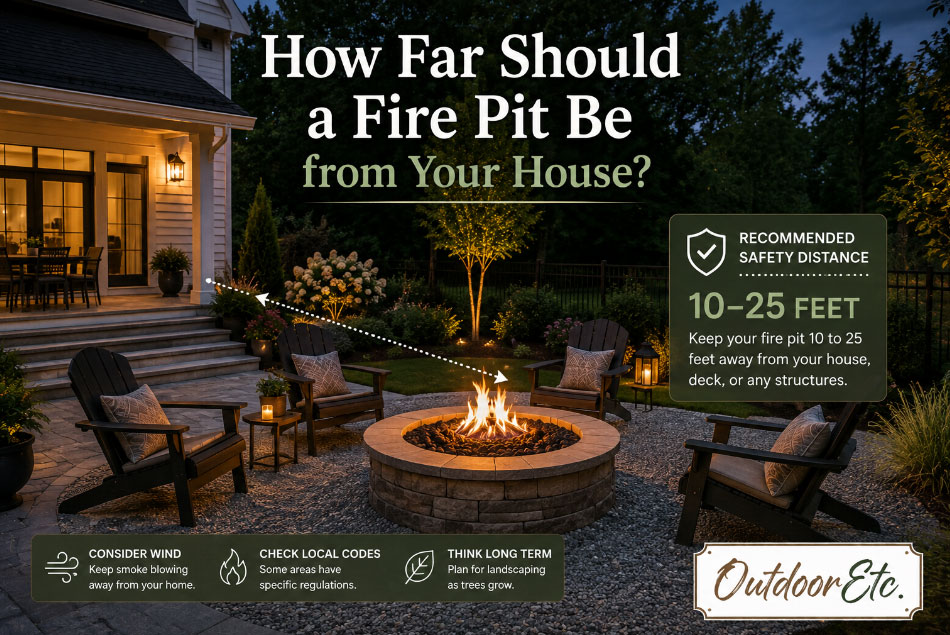
Most fire safety authorities and local fire codes agree on a working range: wood-burning pits require 10 to 25 feet of clearance from homes, garages, fences, trees, and other combustible structures, while gas fire pits generally need only 5 to 10 feet. That gap between the two numbers isn't arbitrary — it reflects a real difference in how each fuel behaves.
For wood fires specifically, the NFPA 1 Fire Code standard for a recreational fire calls for a fuel area no larger than 3 feet in diameter and 2 feet high, with a minimum clearance of 25 feet from any structure or combustible material. Some fire departments enforce a lighter version of that rule — the NFPA also states, in separate consumer guidance, that a fire pit should be positioned at least 10 feet away from any structure. Ten feet is the floor. Twenty-five feet is the standard most likely to keep both your siding and your fire code inspector happy.
Gas and propane pits get more leeway because they don't throw embers, don't need refueling mid-burn, and can usually be shut off instantly. That's why manufacturers of contained gas units often sign off on distances as short as 5 feet, though local code still has the final word.
Why There's No Single Magic Number
Anyone hoping for one universal figure is going to be disappointed, and for good reason. Four variables push that number up or down:
Fuel type. Wood pops, throws sparks, and keeps burning after you've stopped paying attention. Gas doesn't.
Wind. A steady 15 mph breeze can carry a live ember 20 feet or more before it lands. Distance rules assume calm air; real evenings rarely cooperate.
What's nearby. The "structure" in these guidelines isn't only your house. It includes decks, fences, sheds, patio furniture, overhanging branches, and even mulch beds. A fire pit that's 20 feet from your back door but 4 feet from a wooden fence hasn't solved the problem — it's just relocated it.
Local jurisdiction. Your city or county fire marshal outranks every blog post, including this one. Some municipalities mirror the NFPA's 25-foot standard. Others cap wood-burning fires entirely and only permit gas.
What the National Fire Protection Association Actually Says
The NFPA is the closest thing the fire-safety world has to a shared rulebook, and it's worth going to the source rather than a secondhand summary. Their current guidance on outdoor burning and fire pits — including wildfire-specific advice — is published directly on nfpa.org, and it's a genuinely useful five-minute read before you install anything permanent.
Their core position hasn't changed much over the years: keep the pit small, keep it supervised, and keep it far. They also flag a detail people tend to miss — decks. Composite and wood decking are both combustible, and a fire pit sitting directly on a deck surface, even a "safe" distance from the house wall itself, can still scorch or melt the boards beneath it. If a fire pit is going on a deck at all, it needs a fire-rated mat or paver base underneath, non-negotiably.
Wood vs. Gas: Two Different Rulebooks
It helps to see the comparison side by side rather than buried in prose.
| Factor | Wood-Burning Fire Pit | Gas / Propane Fire Pit |
|---|---|---|
| Minimum distance from house | 10–25 feet | 5–10 feet |
| Produces sparks/embers | Yes | Rarely |
| Needs mid-burn refueling | Yes (adds risk) | No |
| Vertical overhead clearance | 21 feet recommended | 21 feet recommended |
| Deck-safe without a barrier | Not generally advised | Sometimes, check manufacturer specs |
| Common jurisdictions banning it | Wildfire-prone counties, dry-season burn bans | Rarely restricted outright |
If your backyard runs on the smaller side, that table alone might settle the wood-versus-gas debate for you. A gas insert can shrink your required footprint by more than half.
The Vertical Rule Nobody Talks About
Everyone fixates on the horizontal distance and forgets fire also travels up. Most placement guidance also calls for at least 21 feet of vertical clearance above the fire pit, protecting against overhanging branches, pergola beams, and eaves. It's easy to measure ten paces across the yard and call it done while a maple branch hangs six feet above the flame pit, waiting for a gust to bring it into contact with rising sparks. Look up before you look sideways.
Two Backyards, Two Outcomes
A composite case, drawn from patterns fire departments see repeatedly, makes the stakes concrete.
At a house on 146 Birchwood Lane, the owners built a stone fire pit 6 feet from a cedar-shingled wall because that's where the patio slab already existed, and pouring new concrete felt like overkill. For two summers, nothing happened. On the third, a dry August evening with gusting wind carried embers into a gap between shingles. The fire department response kept the damage to a single exterior wall section, but the repair bill ran into five figures, and the homeowner's insurer flagged the claim for a site inspection before renewing the policy.
Three streets over, at 89 Sycamore Court, the layout looked almost identical — same lot size, same prevailing wind pattern. But the fire pit sat 18 feet from the house, on a gravel pad, with the nearest fence 12 feet away and no overhanging branches within 25 feet. A similar wind event that same season did nothing more than scatter a few sparks onto bare gravel, where they died out on contact.
Same neighborhood, same weather, same risk exposure — different outcome, entirely explained by twelve feet of planning.
Reading the Wind Before You Read the Tape Measure
A tape measure tells you the static distance. It says nothing about where the fire is actually going to send its embers once it's lit. Position the pit so prevailing winds carry smoke and sparks away from the house, not toward it — check which direction wind typically blows across your property in the evening, since that's when most fire pits get used. If your regional pattern is inconsistent, treat that unpredictability as a reason to add distance rather than assume the wind will cooperate. Embers don't need much: a temperature above ignition point and a few seconds of contact with something dry is enough to start a secondary fire, often unnoticed until it's already spread.
Local Codes, HOAs, and the Fine Print Your City Actually Enforces
NFPA guidance is influential, but it isn't law by itself — local governments decide what actually gets adopted and enforced. Two identical fire pits, one in a suburban subdivision and one in a rural county, can be operating under completely different legal minimums. Before installing anything permanent, pull up your city or county's municipal code. Most local governments now publish theirs online through services like Municode, which lets you search ordinances by state and city without a records request.
A few things worth checking specifically:
- Whether wood-burning fires require a burn permit
- Minimum lot size or setback-from-property-line requirements (separate from house distance)
- Seasonal burn bans, common in drought-prone regions
- HOA-specific restrictions, which are frequently stricter than city code and can require pre-approval of fire pit style, fuel type, and placement
Homeowners associations in particular love to impose rules that exceed the legal minimum — sometimes for aesthetic reasons, sometimes because a prior incident made the board risk-averse. Check the HOA handbook even if the city code gives you a green light.
When Wildfire Risk Changes the Math
In regions where wildfire is a real seasonal threat, the standard 10-to-25-foot guidance gets layered with an entirely separate framework: defensible space zoning. The Insurance Institute for Business & Home Safety lays this out clearly on DisasterSafety.org, where Zone 1, the noncombustible zone immediately around a structure, extends 0 to 5 feet from the building and requires the most careful management of materials in that area. A fire pit sitting inside that inner ring — even a small, well-behaved gas unit — works against the entire purpose of the zone.
Anyone in a wildfire-prone county should treat the standard house-distance guidance as a minimum, not a target, and cross-reference it with the wildfire-specific advice on Ready.gov, which covers broader property preparedness beyond just fire pit placement — things like ember-resistant vents, roof material, and gutter maintenance that matter just as much as where you put your fire feature.
What Happens When the Distance Gets Ignored
The consequences aren't hypothetical scare tactics; they show up in real regulatory data. Even setting aside house-fire scenarios entirely, the U.S. Consumer Product Safety Commission has been sounding alarms specifically about fire pit hazards. In a recent consumer alert, the agency reported that alcohol and other liquid-fuel tabletop fire pits have been associated with two deaths and at least 60 injuries since 2019, a category of incident that has nothing to do with wood embers or wind and everything to do with fuel type and handling. It's a reminder that "how far from the house" is only one variable in a bigger safety picture — what you're burning and how you refuel it matters just as much as where you put it. The full alert is worth a look at CPSC.gov before buying any liquid-fuel or alcohol-burning model.
On the structural side, insurers increasingly ask about fire pit placement during underwriting or claims review. A fire that starts from an improperly placed pit can complicate a homeowner's policy, particularly if local code wasn't followed — some insurers treat code violations as a factor in denying or reducing a claim payout.
A Practical Placement Checklist
Before you set a single stone, run through this:
- Measure the base distance. 10 feet minimum for any fire pit, 25 feet if it's wood-burning and you want to match the stricter NFPA standard.
- Check overhead clearance. No branches, eaves, or pergola beams within 21 feet vertically.
- Map the surrounding structures, not just the house — fences, sheds, wooden decks, and parked vehicles all count.
- Identify prevailing wind direction for typical evening use and orient accordingly.
- Pull your local municipal code through a resource like Municode and confirm permit requirements.
- Check your HOA documents, if applicable, for stricter placement or fuel-type rules.
- Choose a non-combustible base — gravel, pavers, or concrete, never bare grass, mulch, or an unprotected wood deck.
- Keep extinguishing tools within reach — a hose or a filled bucket, positioned before the fire is lit, not after.
- In wildfire-prone regions, cross-check against defensible space zoning, not just structural distance.
Resources Worth Bookmarking
For anyone who wants to go past this guide and check primary sources directly:
- NFPA – Wildfire Prevention Tips for Fire Pits and Outdoor Fires
- CPSC – Consumer Alert on Liquid-Burning Fire Pits
- DisasterSafety.org (IBHS) – Defensible Space Zones
- Ready.gov – Wildfire Preparedness
- Municode – Local Ordinance Lookup
The Bottom Line
Ten feet is the legal floor almost everywhere. Twenty-five feet is the number that lets you stop worrying every time the wind picks up. Somewhere between those two figures is a distance that fits your yard, your fuel type, and your local code — and the only way to find it accurately is to measure, check the wind, and read the actual ordinance instead of guessing. A fire pit is one of the cheapest ways to make a backyard feel like a destination. The distance decision is the one part of that project where cutting corners doesn't save money — it just moves the cost to later, usually with a fire department bill attached.