
Backyard Upgrade Ideas Under $500: A Budget Renovator's Field Guide
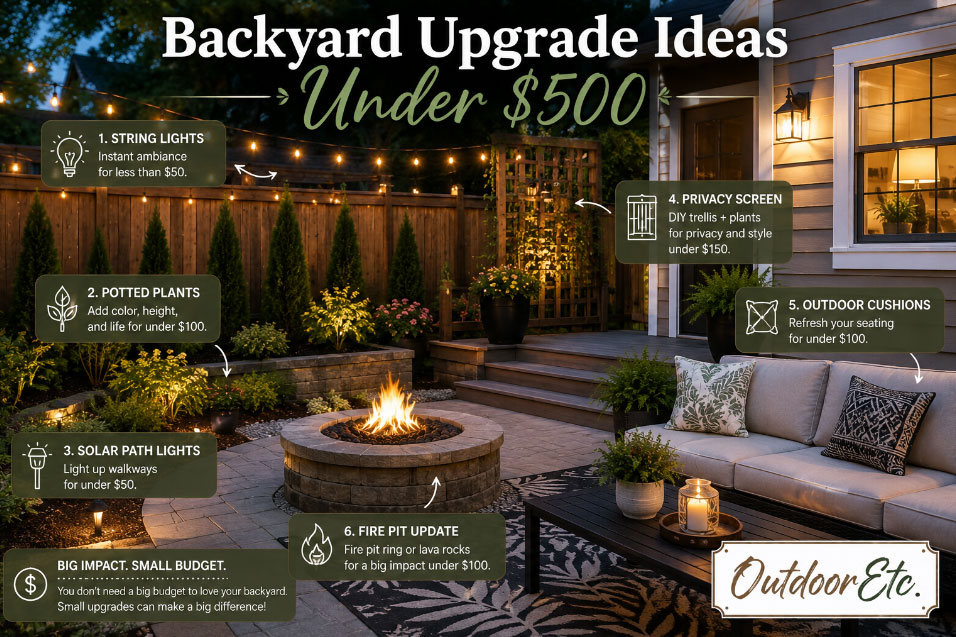
A backyard doesn't need a five-figure renovation to feel like a retreat. Some of the most talked-about outdoor spaces on Pinterest and Instagram were built on weekend labor and a few hundred dollars in materials, not a contractor's invoice. The trick is knowing where a small investment pays off in a big visual way, and where it's better to save your cash for later.
This guide walks through more than a dozen backyard upgrades that each cost under $500 — many of them well under that — along with real numbers, honest difficulty ratings, and links to the retailers where you can actually find the materials. Whether you're working with a concrete slab, a patch of grass, or a blank fenced-in rectangle, there's something here that fits.
Start With a Plan, Not a Shopping Cart
Before buying anything, walk your yard at three different times of day. Note where the sun lands at 8 a.m., at noon, and at 6 p.m. This single habit prevents the most common budget-backyard mistake: building a seating area that turns into a furnace every afternoon, or a garden bed that never gets enough light.
Sketch a rough zone map — even on the back of an envelope works. Divide the space into a few functions: a place to sit, a place to grow things, a path to walk on, and maybe a focal point like a fire feature or a water element. Once you know your zones, a $500 budget stretches much further because every dollar goes toward a specific job instead of a general "yard stuff" pile.
A good rule of thumb for a first-year budget backyard: spend 40 percent on one anchor feature (a patio, a fire pit, or a pergola panel), 30 percent on lighting and greenery, and the rest on furniture and finishing touches like a rug or cushions.
Light It Up: String Lights and Solar Pathways
Lighting delivers the highest visual return per dollar of anything on this list. A yard with warm, layered light looks finished even if the landscaping is still a work in progress.
Outdoor-rated string lights run $25 to $60 for a 48-foot strand, and two or three strands are usually enough to cover a mid-sized patio. Add a handful of solar path lights along a walkway for $30 to $50 total, and a few flickering LED lanterns on the table for another $20. All in, a full lighting overhaul lands comfortably under $150, leaving plenty of room in the budget for other upgrades.
For anyone who wants a more polished look, low-voltage landscape lighting kits from Lowe's or The Home Depot include a transformer and six to eight fixtures for $80 to $150, and installation is a beginner-friendly afternoon project with a shovel and a wire stripper.
Build a Fire Pit That Feels Like a Splurge
A fire pit is the single feature most likely to turn a backyard into the place everyone wants to hang out after dark, and it's one of the cheapest "wow" upgrades available.
A basic steel fire pit bowl costs $60 to $150. For a built-in look, stack retaining wall blocks in a circle — a 36-inch-diameter pit typically needs 20 to 24 blocks, which runs $80 to $180 depending on the style. Add a bag of lava rock or fire glass for the base, a spark screen, and a couple of Adirondack chairs, and the whole project usually finishes between $250 and $400.
Always check local fire codes and homeowners association rules before building, and keep the pit at least 10 feet from any structure or fence line. Retailers like Walmart and Wayfair carry pre-fabricated steel and cast-stone options if stacking block isn't appealing.
Lay Down a Gravel or Paver Patio
Poured concrete patios can run thousands of dollars, but a gravel or paver patio built by hand is a different story entirely. A 10-by-10-foot gravel patio — enough for a small dining set — typically costs $150 to $300 in materials: landscape fabric, paver base, and decorative gravel.
For a slightly more finished look, concrete pavers laid in sand cost a bit more but still stay affordable. A 10-by-10 space using 16-inch square pavers needs about 56 pavers, which runs $200 to $450 depending on the style chosen. This is a weekend project for two people with a shovel, a hand tamper, and a level.
Skip the mortar and cement mixer entirely; a sand-set paver patio can be lifted and adjusted for years if the ground shifts, which makes it far more forgiving for a first-time DIYer.
Hang a Pergola Panel or Shade Sail
A full wooden pergola easily runs into the thousands, but a shade sail or a single attached pergola panel gets most of the same visual impact for a fraction of the price. Triangular or square shade sails made of breathable polyester fabric cost $40 to $120 depending on size, and mounting hardware adds another $30 to $50.
For a more architectural look, a wall-mounted pergola bracket kit — essentially a partial pergola attached to the house — runs $200 to $450 in lumber and hardware for an 8-by-10-foot coverage area. Both options cut afternoon sun by 70 to 90 percent, which matters more than people expect once July arrives.
Create a Living Privacy Screen
Fence-line privacy doesn't require a full fence rebuild. Bamboo screening rolls attach directly to an existing chain-link or wood fence and cost $30 to $80 for a 6-by-16-foot roll. For a greener option, a row of fast-growing arborvitae or clumping bamboo in large planters creates a living wall within a season or two, and a dozen 3-gallon plants typically run $200 to $350 total.
Lattice panels are another budget-friendly route — a 4-by-8-foot cedar lattice panel costs $25 to $45, and three or four panels mounted on simple posts can screen an entire patio corner for under $200.
Plant a Raised Garden Bed
Raised beds solve two problems at once: they look intentional and tidy, and they make gardening dramatically easier on the back and knees. A cedar raised bed kit, roughly 4 by 8 feet, costs $80 to $200. Filling it with a mix of garden soil and compost adds another $60 to $120 depending on the depth.
For under $500, it's realistic to build two or three beds, fill them, and still have room in the budget for starter plants or seeds from a nursery. Gardener's Supply Company and local garden centers both carry cedar kits, and building one from scratch with untreated lumber can shave the cost down even further for anyone comfortable with a drill.
Add a Vertical Garden Wall
For smaller yards or patios, a vertical garden solves the space problem entirely. Modular wall planter systems cost $30 to $100 for a starter kit covering roughly 4 square feet, and a pallet-style vertical garden can be built from a single reclaimed pallet for the cost of soil, landscape fabric, and a handful of screws — often under $50.
Herbs, strawberries, and trailing succulents all do well in vertical setups, and the format works equally well against a bare fence, a garage wall, or the side of a shed that's never had a purpose before.
Bring in a Small Water Feature
The sound of moving water changes how a backyard feels almost instantly, and it doesn't require a pond excavation. Solar-powered fountains for existing planters or small basins cost $40 to $90. A pre-formed basin fountain kit — pump, basin, and decorative rock — runs $100 to $250 and installs in an afternoon.
For something with more presence, a ceramic or cast-stone tiered fountain from Wayfair or Target costs $150 to $400 and needs only a nearby outdoor outlet.
Refresh Furniture With Paint and Cushions
Before buying new patio furniture, it's worth checking whether existing pieces can be saved. A can of spray paint rated for metal or outdoor use costs $8 to $12, and a full set of chairs can usually be refinished for under $50 in materials. New outdoor cushions run $15 to $40 per chair, and a full seating refresh — paint plus cushions for a four-chair set and a small table — typically lands under $250.
If starting from nothing, budget bistro sets from IKEA or Walmart start around $100 to $200 for a table and two chairs, leaving room in a $500 budget for lighting or a rug on top.
Hang a Hammock or Porch Swing
Few upgrades create as much lounging appeal per dollar as a hammock. A quality camping-style hammock with a stand costs $80 to $200, while a tree-hung version (if two suitably spaced trees exist) can cost as little as $30 to $60 for the hammock alone.
A porch swing, if there's a covered area or a sturdy tree branch to hang it from, runs $100 to $250 including chain and mounting hardware. Either option instantly signals "relax here" in a way that furniture alone often doesn't.
Build a Mini Outdoor Bar Cart or Grill Station
A dedicated spot for drinks or grilling makes a backyard feel like an extension of the kitchen rather than an afterthought. A rolling bar cart, either purchased or built from a simple shelving unit, costs $60 to $150. Adding a small side table, a cooler, and a few string lights overhead rounds out a functional station for well under $250.
For grill owners, a simple wood-framed grill station — essentially a counter with storage built around an existing grill — can be built from pressure-treated lumber for $150 to $350, depending on size.
Repaint the Fence or Add Stain
An old, gray, weathered fence quietly drags down the entire look of a yard, and repainting or staining it is one of the most underrated upgrades on this list. A 5-gallon bucket of exterior stain or solid fence paint covers roughly 500 to 600 square feet and costs $80 to $150. For a typical suburban backyard fence, two buckets and a weekend of rolling and brushing usually finishes the job for $200 or less.
Darker charcoal and black stains have become especially popular because they make greenery in front of the fence pop visually, an effect landscape designers call the "backdrop trick."
Define Zones With an Outdoor Rug
An outdoor rug does for a patio what a rug does for a living room: it defines the space and makes furniture arrangements look deliberate instead of scattered. Polypropylene outdoor rugs in the 5-by-7-foot range cost $40 to $90, while 8-by-10-foot sizes run $70 to $150. They're weather-resistant, easy to hose off, and instantly make a bare concrete slab look like a designed space.
Comparison Table: Backyard Upgrades at a Glance
| Upgrade Idea | Estimated Cost | Difficulty | Time to Complete | Best For |
|---|---|---|---|---|
| String & solar lighting | $50 – $150 | Easy | 1–2 hours | Instant ambiance, any yard |
| Fire pit (block or steel) | $150 – $400 | Moderate | 1 weekend | Evening gatherings |
| Gravel or paver patio (10x10) | $150 – $450 | Moderate | 1–2 weekends | Dining or seating area |
| Shade sail or pergola panel | $70 – $450 | Easy–Moderate | 1 day | Sun protection |
| Living privacy screen | $30 – $350 | Easy | Half day | Fence-line privacy |
| Raised garden bed(s) | $140 – $500 | Easy | 1 day | Growing food, tidy look |
| Vertical garden wall | $30 – $100 | Easy | 2–3 hours | Small yards, patios |
| Small water feature | $40 – $400 | Easy | 2–4 hours | Ambiance, focal point |
| Furniture refresh (paint) | $50 – $250 | Easy | 1 weekend | Reusing existing pieces |
| Hammock or porch swing | $30 – $250 | Easy | 1–2 hours | Lounging, focal point |
| Bar cart or grill station | $60 – $350 | Easy–Moderate | 1 day | Entertaining |
| Fence paint or stain | $80 – $200 | Moderate | 1 weekend | Whole-yard visual upgrade |
| Outdoor rug | $40 – $150 | Easy | 15 minutes | Zoning a patio |
Where to Shop Smart
Pricing on outdoor materials swings widely between retailers, so it's worth comparing a few before committing a chunk of that $500 budget to one purchase.
- The Home Depot — pavers, lumber, retaining wall block, and stain, often with in-store pickup the same day.
- Lowe's — comparable pricing to Home Depot, frequently runs seasonal discounts on patio furniture and lighting in early spring.
- IKEA — budget furniture, planters, and outdoor textiles.
- Wayfair — fountains, fire pits, and furniture sets, useful for comparing styles across brands in one place.
- Walmart — string lights, bistro sets, and fire pit bowls at some of the lowest entry prices available.
- Target — decorative accents, cushions, and small-space furniture.
- Gardener's Supply Company — raised bed kits, trellises, and vertical planting systems.
- Facebook Marketplace — secondhand patio furniture and pavers, often at 50 to 80 percent off retail.
Checking a local Habitat for Humanity ReStore or a neighborhood salvage yard before buying new lumber or block is also worth the detour; reclaimed pavers and cedar boards routinely sell for a third of retail price.
Frequently Asked Questions
What's the single best backyard upgrade under $500?
For most yards, layered outdoor lighting combined with a fire pit delivers the biggest transformation for the least money, usually landing between $250 and $400 total while making the space usable well after sunset.
Can a full backyard makeover really happen for under $500?
A full makeover isn't realistic, but a meaningful, visible transformation is. Combining two or three items from this list — lighting, a seating zone, and a privacy or greenery element — typically covers the areas that matter most to how a yard looks and feels.
What backyard upgrades add the most resale value?
Landscaping refreshes, fence repairs, and defined patio areas tend to matter most to buyers, according to real estate appraisers, because they signal that the outdoor space has been maintained rather than neglected.
Do I need a permit for a DIY fire pit or patio?
Requirements vary by city and HOA, so it's worth a quick call to the local building department before starting. Portable, above-ground fire pits typically don't require a permit, while permanent, built-in patios sometimes do depending on size and drainage requirements.
What tools do I need to get started on a budget backyard project?
A basic kit covers almost everything on this list: a shovel, a hand tamper or hand tools for leveling, a drill, a level, work gloves, and a wheelbarrow if moving gravel or soil. Most of these projects don't require power tools beyond a drill.
Final Thoughts
A backyard doesn't reveal its budget the way people assume it will. A well-placed string of lights, a stack of retaining wall block turned fire pit, and a fresh coat of stain on a tired fence can do more for how a space feels than a five-figure renovation ever could — because the choices are deliberate rather than default.
Start with one anchor project, add lighting, and let the rest of the yard fill in over a season or two. Five hundred dollars spent with a plan goes a long way further than five hundred dollars spent on impulse.